


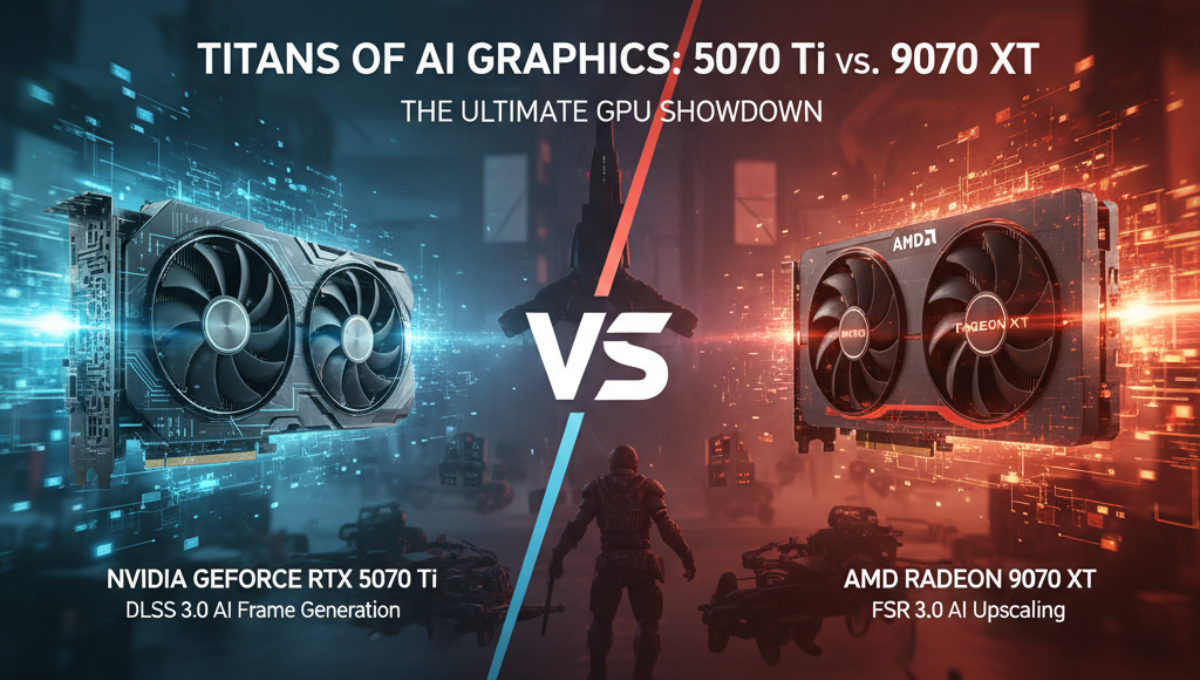
In the rapidly evolving world of gaming and high-performance computing, the graphics processing unit (GPU) remains the cornerstone of immersive visuals and smooth gameplay. As technology advances, gamers and professionals alike are eagerly awaiting the next generation of GPUs that promise to redefine performance benchmarks. Among these, the Nvidia GeForce RTX 5070 Ti and AMD Radeon 9070 XT stand out as flagship contenders, each equipped with cutting-edge features like AI-driven upscaling technologies—DLSS (Deep Learning Super Sampling) from Nvidia and FSR (FidelityFX Super Resolution) from AMD. This article provides a comprehensive, in-depth comparison of these two titans, exploring their architecture, features, performance, and the implications for gamers and creators.
The Evolution of GPU Technology
Before diving into the specifics, it’s essential to understand the context of GPU evolution. Traditionally, GPUs have focused on raw rasterization power, but recent innovations have shifted emphasis toward intelligent rendering techniques that enhance visual fidelity without sacrificing performance. Nvidia’s DLSS and AMD’s FSR exemplify this trend, using AI and spatial upscaling to deliver higher frame rates and better image quality.
Introducing the Contenders
Nvidia GeForce RTX 5070 Ti
Building upon Nvidia’s renowned RTX series, the RTX 5070 Ti is expected to feature the latest architecture—likely a refined version of Ada Lovelace or a new architecture that emphasizes efficiency and performance. It is anticipated to include:
- Enhanced ray tracing cores for realistic lighting and shadows
- Increased CUDA cores for greater parallel processing
- Support for DLSS 3.0, incorporating AI frame generation for ultra-smooth gameplay
- Advanced cooling solutions and power efficiency
AMD Radeon 9070 XT
AMD’s Radeon 9070 XT is poised as the flagship GPU from AMD’s latest lineup, potentially based on a new RDNA 3.5 or RDNA 4 architecture. Key features are expected to include:
- State-of-the-art ray tracing capabilities
- More compute units and stream processors for competitive performance
- Support for FSR 3.0, leveraging AI and temporal upscaling
- Competitive power efficiency and innovative cooling designs
Architectural Insights
Nvidia’s Architecture and AI Upscaling
Nvidia’s RTX 5070 Ti is likely to continue its leadership in AI integration, with DLSS 3.0 representing a significant leap. DLSS uses deep learning models trained on vast datasets to generate higher-resolution frames from lower-resolution inputs, effectively boosting frame rates without compromising visual quality. The new iteration promises:
- Frame generation capabilities that smooth out motion
- Better handling of complex scenes
- Compatibility with a wide array of titles and applications
AMD’s FSR and Future-proofing
AMD’s FSR, now in its third iteration, emphasizes open standards and broad compatibility. FSR 3.0 introduces temporal upscaling and AI-enhanced algorithms that aim to match or surpass Nvidia’s DLSS in quality. Notable features include:
- Compatibility with a wider range of hardware, including older GPUs
- Improved temporal stability and image sharpness
- Lower latency and higher frame rates in demanding titles
Performance Showdown
While real-world benchmarks are yet to be fully published, early leaks and synthetic tests suggest a close race:
- Gaming Performance: Both GPUs are expected to excel in 4K gaming, with the RTX 5070 Ti possibly leading slightly due to more mature AI upscaling and ray tracing cores.
- Ray Tracing and Visual Fidelity: Nvidia’s hardware traditionally has an edge here, but AMD’s latest innovations aim to close the gap.
- AI Upscaling Efficacy: DLSS 3.0 may offer more seamless frame generation, but FSR 3.0’s broader compatibility and open-source approach make it a compelling alternative.
Features and Software Ecosystem
- Nvidia’s Ecosystem: GeForce Experience, Reflex, Broadcast, and a robust driver support system enhance user experience.
- AMD’s Ecosystem: Radeon Software, FidelityFX suite, and Smart Access Memory provide seamless integration for AMD users.
Power Consumption and Cooling
Efficiency is vital for gamers and professionals who seek high performance without excessive heat or power draw. The RTX 5070 Ti is expected to leverage Nvidia’s advancements in power efficiency, while AMD’s new architecture also emphasizes lower TDPs and innovative cooling solutions.
Pricing and Availability
Pricing remains speculative but is anticipated to be competitive, with Nvidia potentially pricing the 5070 Ti slightly higher due to its advanced AI features. Availability may also be influenced by supply chain conditions, but both cards are expected to be accessible by the holiday season.
Final Verdict
The ultimate choice between Nvidia GeForce RTX 5070 Ti and AMD Radeon 9070 XT hinges on individual needs:
- For gamers seeking the best ray tracing and AI-powered upscaling, Nvidia’s offering is likely the superior choice.
- For those valuing open standards, broader compatibility, and potentially better value, AMD’s Radeon 9070 XT presents a compelling alternative.
Both GPUs exemplify the future of gaming and professional graphics, harnessing AI to deliver breathtaking visuals and exceptional performance. The faceoff underscores a new era where intelligent upscaling and real-time rendering redefine what’s possible in digital entertainment.
Conclusion
As Nvidia and AMD push the boundaries of GPU technology, consumers are the ultimate beneficiaries. The RTX 5070 Ti and Radeon 9070 XT represent two different philosophies— Nvidia’s proprietary AI-driven innovations versus AMD’s open, adaptable approach. Whichever you choose, one thing is clear: the future of high-performance graphics is bright, intelligent, and more immersive than ever before.
